
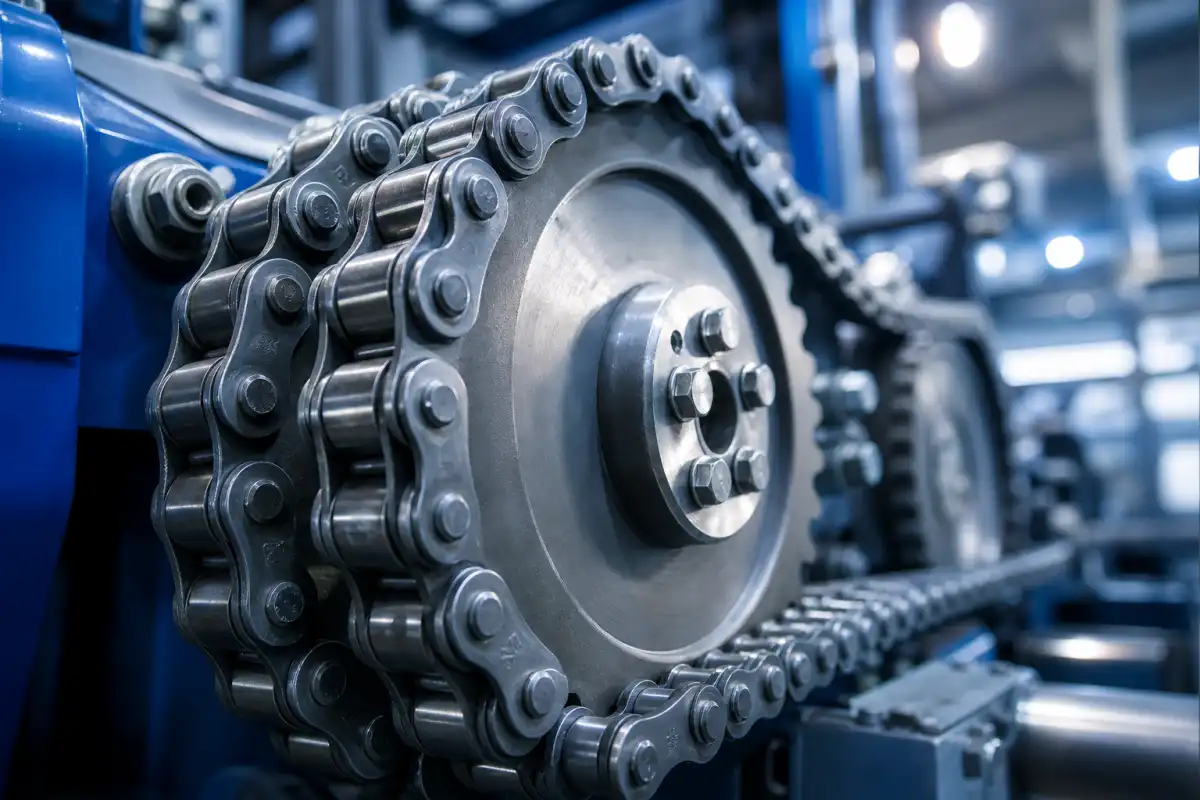
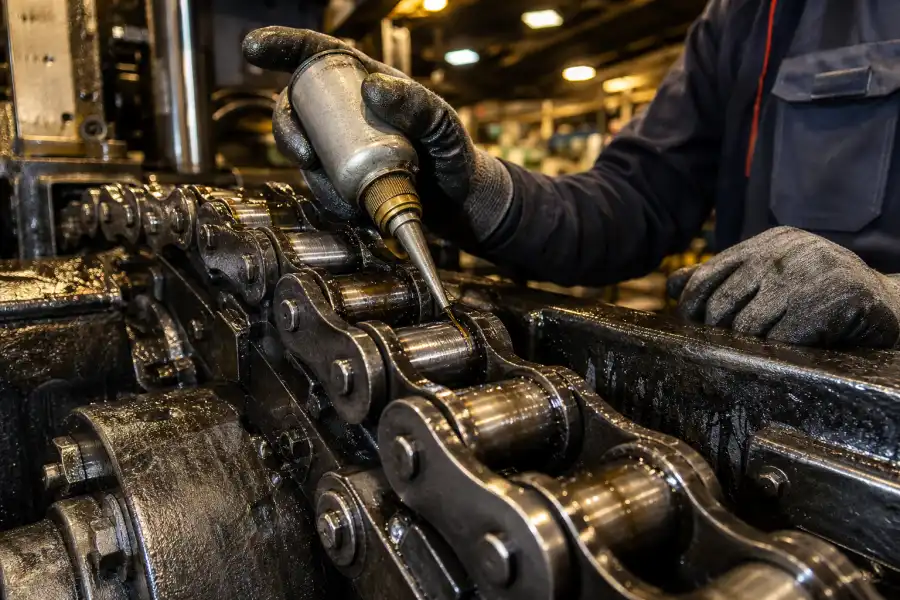
Industrial chain lubrication is one of the most critical maintenance procedures that directly determines the performance and lifespan of power transmission systems. Used across numerous industrial fields, from factory production lines to mines, and from food processing plants to automotive assembly lines, chain and gear systems, they wear rapidly, fail and cause unplanned downtime without regular and correct lubrication. In this guide, we comprehensively cover every detail of industrial chain lubrication processes, maintenance procedures and wear control methods.
Why Is Industrial Chain Lubrication Critically Important?
Industrial chain systems form the backbone of mechanical power transmission. Different types, such as roller chains, conveyor chains and lifting chains, each have different lubrication requirements depending on their operating conditions. When correct lubrication is not applied;
- Wear rate increases 3-5 times — metal-to-metal contact between chain pins and bushings running without oil directly causes wear
- Energy efficiency drops by 15-20% — increased friction leads to power loss and higher electricity consumption
- Noise level rises significantly — chains running dry produce characteristic impact and friction noises
- Unexpected failures and unplanned downtime occur — unmaintained chains can cause sudden breakages
In industrial facilities of common causes of failure the vast majority stem from insufficient or incorrect lubrication. For this reason, chain lubrication is not merely a maintenance step but a guarantee of operational continuity.
Chain Lubrication Types and Application Methods
1. Hand Lubrication (Manual Lubrication)
This is the simplest lubrication method, preferred in small-scale facilities and low-speed applications. Oil is applied directly to the chain using a brush or drip can. Manual lubrication:
- Is effective in low-speed conveyor systems
- Is suitable for equipment operating at irregular intervals
- Allows oil consumption to be kept under control
- However, carries a risk of inconsistent application
2. Drip Lubrication Systems
This is the most widely used method under medium speed and load conditions. Oil is dripped onto the chain pins in a controlled manner via an adjustable drip system. In drip lubrication systems:
- The drip rate is adjusted according to the chain width and speed
- Generally 4-20 drops per minute are applied
- Regular inspection of the oil reservoir is required
- A filter system must ensure a clean oil flow
3. Oil Bath (Immersion) Method
This is the most effective lubrication method for chain systems operating under high speed and heavy load conditions. The lower section of the chain is partially immersed in an oil bath, and the rotating chain continuously carries the oil. This method:
- Provides a smooth and continuous oil film
- Helps with heat dissipation
- Is preferred in high-speed applications
- Requires the oil level and quality to be checked regularly
4. Centralised Lubrication Systems
Used in large industrial facilities on lines with numerous chain systems. Oil is automatically distributed through a network of pumps, pipes and nozzles. Centralised lubrication:
- Minimises the risk of human error
- Provides timing and quantity control
- Guarantees even distribution across long chain lines
- Delivers long-term savings despite a high initial installation cost
Selecting the correct lubrication method for different chain types and operating conditions of chain assembly and installation processes should be regarded as part of
Choosing the Right Oil: Viscosity, Additives and Operating Conditions
Selecting the correct oil for use in industrial chain lubrication is just as important as the lubrication method itself. Oils with the wrong viscosity or unsuitable additives can cause premature wear of the chain.
Viscosity Selection
Oil viscosity should be determined according to operating temperature and chain speed:
- Low-speed applications (0-3 m/s): VG 220-460 viscosity grade oils
- Medium-speed applications (3-8 m/s): VG 68-150 viscosity grade oils
- High-speed applications (8+ m/s): VG 32-68 viscosity grade oils
- Extreme load conditions: EP (Extreme Pressure) additive oils should be preferred
Oil Selection for Special Operating Conditions
- High temperature (>150°C): Synthetic-based, thermally stable oils
- Low temperature (<-20°C): Oils with a low pour point
- Food industry: NSF H1-approved food-grade oils
- Humid/corrosive environments: Rust-inhibiting additive oils
- Dusty environments: Low-ash content, clean-running oils
For more detailed information on oil selection, material selection in industrial chain and sprocket systems you can read our article on this topic.
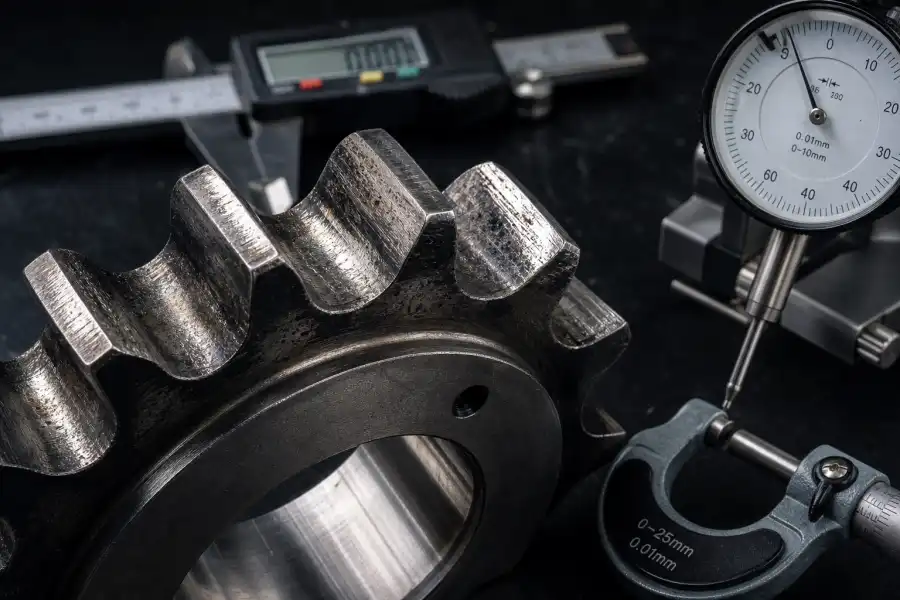
Chain Maintenance Procedures and Periodic Inspection Checklist
Regular maintenance ensures that industrial chain systems operate predictably. The periodic inspection checklist below helps maintenance teams work systematically:
Daily Checks
- Chain tension check — a chain that is too loose or too tight accelerates wear
- Lubrication condition observation — detecting dry areas or excessive oil build-up
- Unusual noise and vibration check — abnormal noise is an early warning sign
- Visual inspection of sprocket surface for damage
Weekly Checks
- Oil level and oil quality check
- Chain connection point looseness check
- Sprocket alignment check — misalignment causes asymmetric wear
- Condition of protective covers and guards
Monthly Checks
- Zincir uzama ölçümü — %2-3’ten fazla uzama değişim zamanı geldiğinin göstergesidir
- Sprocket tooth profile wear check — thinning or sharpening of the teeth
- Bearing temperature and noise check
- Oil sample analysis — metal particle ratio and oil degradation indicators
Annual Inspections
- Comprehensive system inspection and load test
- Full oil change and system cleaning
- Chain and sprocket replacement assessment
- Calibration of safety devices and sensors
Complete implementation of periodic inspection processes, chain and sprocket wear inspection when evaluated together, significantly increases the reliability of the system.
Chain Wear Symptoms and Early Warning Signals
Wear in industrial chain systems is a gradual process, and costly failures can be prevented when it is recognised early. The signs below indicate that it is nearly time to replace the chain:
Visible Signs
- Shine and scratches on chain pins — surface damage caused by friction
- Ovalisation on the roller surface — indicator of asymmetric load distribution
- Fish-hook wear formation on sprocket teeth — deformation of the tooth profile
- Corrosion on chain connecting pins — resulting from moisture or chemical exposure
Performance Indicators
- Increased noise level during chain operation
- Rise in vibration levels
- Increase in motor current (due to increased friction)
- Chain jumping or jamming incidents
Measurable Indicators
- Zincir perdesinde %2’den fazla uzama
- Dişli çapında %1-2’lik azalma
- Increase in bearing clearance
When any of these indicators is detected, dimensional and tolerance accuracy should be checked and the chain's service life assessed.
Critical Points to Observe in Lubrication Application
For industrial chain lubrication to be effective, certain critical rules must be observed:
Preparation Before Lubrication
- Clean the chain — remove old oil, dust and metal particles
- Identify the lubrication points — the pin and bushing interfaces are priority areas
- Take the necessary safety precautions — keep clear of moving parts and use PPE
- Prepare the correct oil — select an oil of the viscosity and type recommended by the manufacturer
Points to Note During Lubrication
- Apply the oil to the inner surface of the chain — the pin-bushing interfaces should be targeted rather than the outer surface
- Avoid over-lubrication — excess oil attracts dust and dirt, accelerating wear
- Ensure even distribution — a uniform oil film must form along the entire chain
- Apply oil to the chain while it is warm — on a cold chain, oil fluidity is low and penetration is difficult
Post-Lubrication Checks
- Check for excessive oil leakage
- Readjust the chain tension
- Refit the protective guards
- Update the lubrication record — date, oil type, quantity and the personnel who carried it out
Full and consistent application of lubrication procedures SKF chain drive system recommendations and Renold chain maintenance guidelines should be in line with
Common Lubrication Mistakes and Their Consequences
Lubrication mistakes encountered in industrial facilities can lead to serious operational losses. The most common mistakes and their consequences are as follows:
1. Incorrect Viscosity Selection
Using a low-viscosity oil fails to build sufficient film thickness and cannot prevent metal-to-metal contact. High-viscosity oil, on the other hand, cannot penetrate on cold starts and causes energy loss. In both cases, the wear rate increases significantly.
2. Irregular Lubrication Intervals
Skipping lubrication or applying it irregularly causes the oil film to break down, leading to periods of dry running. The micro-wear that builds up during these periods can shorten chain life by 40-60%.
3. Incompatible Oil Mixing
Mixing different base oils or incompatible additives can degrade the oil's chemical structure, leading to sediment formation, foaming or loss of viscosity.
4. Neglecting Contamination Control
Contaminants such as dust, metal particles and moisture mixing into the oil create an abrasive effect. Even clean oil becomes a factor that accelerates wear once contaminated.
5. Over-lubrication
Over-lubrication increases the build-up of dust and dirt, forms a sticky layer on the chain and adversely affects heat dissipation. In the food industry, it also creates a risk of product contamination.
Lubrication Strategies for Special Industrial Conditions
Food Industry
NSF H1-approved food-grade oils are mandatory for chains used in food processing facilities. These oils are considered safe even in the event of incidental food contact. In the food industry, lubrication intervals should be more frequent and the risk of oil spillage must be minimised.
High-Temperature Applications
Fırın, kurutma odası ve sinterleme tesislerinde zincirler sürekli yüksek sıcaklığa maruz kalır. Bu koşullarda sentetik bazlı, yüksek termal kararlılığa sahip yağlar kullanılmalıdır. Mineral yağlar 120°C’nin üzerinde hızla bozulur ve kalıntı bırakır.
Outdoor Use and Extreme Cold
In outdoor applications, oil can lose its fluidity at low temperatures. Oils with a low pour point should be selected, and cold-start procedures should be applied. Anti-corrosion additives are also critical for these environments.
Chemical and Corrosive Environments
In chemical and metallurgical plants, acid vapours, alkaline liquids and abrasive dust can degrade chain oil. Special chemically resistant oils and frequent lubrication intervals are required in these environments.
Digital Maintenance Management and Smart Monitoring Systems
With the Industry 4.0 transformation, chain maintenance management is also becoming digitalised. Smart sensors and monitoring systems offer real-time data collection and analysis:
- Vibration analysers — continuous monitoring for early wear detection
- Temperature sensors — overheating alerts and lubrication effectiveness checks
- Smart lubrication systems — automatic, demand-based oil distribution
- Predictive maintenance software — data-driven maintenance planning and failure prediction
Bu teknolojilerin entegrasyonu, yağlama bakım maliyetlerini %25-30 oranında düşürebilir ve plansız duruşları %50’ye kadar azaltabilir. Dijital bakım yönetimi, özellikle büyük ölçekli endüstriyel tesislerde ensuring operational continuity , particularly in large-scale industrial facilities.
Conclusion: The Strategic Importance of Industrial Chain Lubrication and Maintenance
Industrial chain lubrication should no longer be seen as a simple maintenance activity, but assessed as a strategic component of operational excellence. The correct choice of oil, appropriate application method, regular periodic inspection and the integration of digital monitoring systems, the chain systems' industrial chain lubrication ensures they achieve peak performance in your processes.
An unmaintained or inadequately lubricated chain system can lead to production downtime, energy loss and safety risks. A systematic lubrication and maintenance programme, on the other hand:
- Extends chain life by 2-3 times
- Reduces energy consumption by 15-20%
- Minimises unplanned downtime
- Significantly lowers total cost of ownership
- Improves workplace safety
At Gurur Makina, aware of the importance of correct lubrication and maintenance practices in industrial chain and gear systems, we provide our customers with technical support and consultancy on selecting the right products. Industrial chain lubrication you can contact our expert team to optimise your processes and extend the service life of your systems.
maintenancegearindustrial chainpower transmission