
OVERVIEW
Conveyor Chains
CATALOGUE
You can click the link below to download our general catalogue covering all our products.
Download Catalogue PDFM/MC/MT SERIES CHAINS
 You can download the technical document about the product from the link below.
PDF Catalogue
You can download the technical document about the product from the link below.
PDF Catalogue FV/FVT/FVC SERIES CHAINS
 You can download the technical document about the product from the link below.
PDF Catalogue
You can download the technical document about the product from the link below.
PDF Catalogue Y/YT/YC SERIES CHAINS
 You can download the technical document about the product from the link below.
PDF Catalogue
You can download the technical document about the product from the link below.
PDF Catalogue NON-STANDARD CONVEYOR CHAINS
 You can download the technical document about the product from the link below.
PDF Catalogue
You can download the technical document about the product from the link below.
PDF Catalogue NON-STANDARD STAINLESS STEEL CONVEYOR CHAINS
 You can download the technical document about the product from the link below.
PDF Catalogue
You can download the technical document about the product from the link below.
PDF Catalogue CONVEYOR CHAINS
 You can download the technical document about the product from the link below.
PDF Catalogue
You can download the technical document about the product from the link below.
PDF Catalogue CUSTOM-MANUFACTURED CHAINS
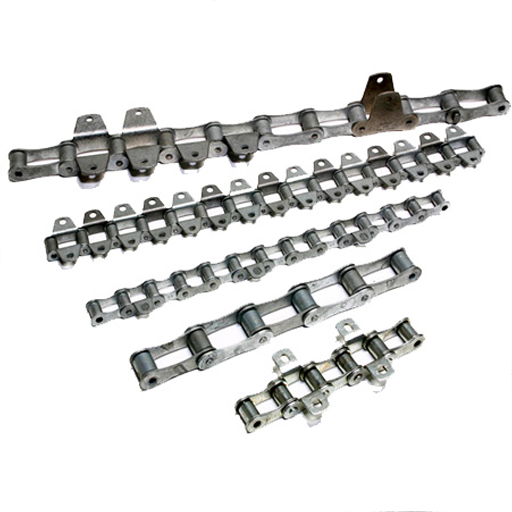 You can download the technical document about the product from the link below.
PDF Catalogue
You can download the technical document about the product from the link below.
PDF Catalogue Conveyor Chains
Conveyor chains stand out as a technology product that makes a significant contribution to the modernisation of numerous businesses. With attachments and chain lugs, this model comes to us as one designed for conveying and transfer purposes. Conveyors also hold a very important place within fabrication production systems. Establishing and regularly monitoring work processes produces more efficient, advantageous results with this system.
A short note: as Gurur Makina, we have been supplying the finest chains to our customers and serving them since 1986. Turkey's chain brand
Products arranged in sequence sit at a certain height, and this ensures a smooth workflow. In the process, workers are seen to gain a significant advantage in terms of ergonomics. Conveyors, known as production lines, are found in modernised workplaces. To get a clear picture of this system's efficiency, the modern working systems found in factories will give you a good idea.
Conveyors and conveyor chains play a vital role in the movement of products and goods. This gives rise to highly advantageous product examples in both production and transport — sometimes a PVC belt, sometimes a belt model supported by wooden pallets, making it possible to build highly functional production lines. In this process, conveyor chains, designed and used efficiently, must fulfil a very important function within the system.
What Are Conveyor Chains Used For?
Conveyor chains is vital for transport belts and production lines. Double-pitch chain models with attachment support are a transport model found in use in many factories and companies. While this system enables the transfer of products, it is also the system and materials required for ergonomic and functional product belts. As processes such as preparation, production and packaging are carried out on conveyors, this makes it possible to increase production performance and speed up manufacturing.
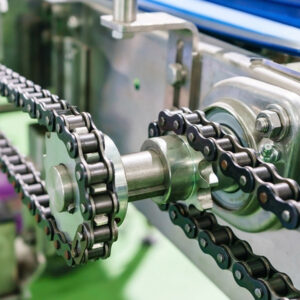
Motor power is required to operate a conveyor system. Transferring the effect of this power to a gear, and from there to the conveyor chains, is an essential requirement. To handle the line's capacity, chains are manufactured from carbon-reinforced iron. Known as steel, these metals are among the indispensable materials for conveyors thanks to their hard and durable structure. Conveyors, which can span many metres in length, operate for long periods and provide reliable service to businesses thanks to robust gear and chain support.
Conveyor Chain Models
The motor and gear structure that drives the conveyor determines the chain structure to be used. Chain length is generally limited by the system's maximum power. If the required service length is greater, several conveyors are joined end to end to complete the system.

Effective in production and transport, these products offer businesses significant industrial advantages through the wide variety of models available. During the initial installation of the system, expert input and a high-quality production process ensure the products are properly supplied. In cases of wear and tear, work carried out to replace the chain provides an important advantage in terms of the system's efficiency.
Chain models also vary according to conveyor models. Support from these products is required for serial production and easy transport. Advantageous in terms of system maintenance, these products deliver a durable result thanks to their material quality. In cases of deformation occurring over time, repair and replacement work provides a solution to the problem.
Our Conveyor Chain Services
The conveyor chain models within our range will continue to be an important part of the system you want to own or keep running efficiently. Conveyor breakdowns are largely caused by chains. Chains in continuous operation reveal certain problems due to friction, heating and wear.
In such cases, you can let us know the chain model and quantity you need and get our help with it. As a company, we always provide you with the support you require through robust, new and high-quality chain models. There are also companies that keep chain sets in stock to avoid any disruption to production. Our company's constant readiness to supply presents a general advantage for businesses.
We are ready to support you with every product you need regarding conveyor chain models. We are committed to delivering the products featured on our product category pages to you in the most suitable way. We recommend choosing us for chain supply to keep your conveyor system running efficiently.
What Is a Conveyor Chain?
A conveyor chain is a chain family with a larger pitch and wider plates than transmission chain, used to move products or materials from one point to another. While transmission chain is designed to transmit power, conveyor chain is designed to carry loads .
This difference is reflected in the structure: conveyor chains have a large pitch (generally 50 mm and above), flat and tall plates, and a roller diameter selected according to the carrying surface. In most applications, an attachment (lug) is fitted to the chain to mount slats, pallets or carrier elements.
Difference Between Conveyor Chain and Transmission Chain
| Feature | Conveyor chain | Transmission chain |
|---|---|---|
| Purpose | Carrying loads | Transmitting power |
| Pitch | Large (50-250 mm) | Small (9.5-38 mm) |
| Speed | Low | Medium-high |
| Roller | Large diameter, load-bearing | Small, seats on the sprocket |
| Attachment | Present in most applications | Optional |
| Lubrication | Limited, often dry on a guide rail | Continuous lubrication preferred |
M, FV and Y Series Conveyor Chains
M series
The most common conveyor chain family covered by DIN 8167 / ISO 1977. The number in the code indicates the approximate breaking load in kN: M40 approximately 40 kN, M112 has a breaking load of approximately 112 kN.
| Code | Approximate breaking load (kN) | Common pitches (mm) |
|---|---|---|
| M20 | 20 | 50 · 63 · 80 · 100 |
| M28 | 28 | 50 · 63 · 80 · 100 · 125 |
| M40 | 40 | 63 · 80 · 100 · 125 · 160 |
| M56 | 56 | 63 · 80 · 100 · 125 · 160 · 200 |
| M80 | 80 | 80 · 100 · 125 · 160 · 200 · 250 |
| M112 | 112 | 100 · 125 · 160 · 200 · 250 |
| M160 | 160 | 125 · 160 · 200 · 250 · 315 |
| M224 | 224 | 160 · 200 · 250 · 315 |
The MC and MT variants denote a difference in roller type: MC generally has a larger carrying roller, while MT features a special roller arrangement. The variant of the existing chain on the machine should be checked together with the width of the carrier rail.
FV series
The FV, FVT and FVC series are used especially on heavy industrial conveying lines. Plate height and pin diameter are larger than in the M series, making them preferred for conveying heavy and abrasive materials. The number in the code again indicates the breaking load class (FV63, FV90, FV112, FV140, FV180).
Y series
The Y, YT and YC series are carrying chains with taller, flat plates. They are used on lines conveying pallets and large parts, in applications where the product sits directly on the plate.
Attachment (Lug) Types
The conveying function of the conveyor chain is most often provided by an attachment fitted to the chain:
- K type (straight lug): A flat mounting surface perpendicular to the plate. Standard for slat and pallet connections.
- A type (side lug): Extends to the side of the plate; used for side-carrying and guiding applications.
- Extended pin: One end of the pin is extended, and the pusher or carrying element is attached directly to the pin.
- Extended plate: The plate itself is enlarged so that it forms the carrying surface.
As well as the lug type, lug spacing the lug spacing must also be specified when ordering attachments: every link (K1), every other link (K2), or less frequently. Two chains of the same pitch cannot be used interchangeably if their lug spacing differs.
Material and Surface Selection
- Carbon steel: General industrial conveying lines.
- Galvanised coating: Damp environments and outdoor use; increases corrosion resistance.
- Stainless steel: Food, pharmaceutical, chemical. The standard for lines subject to wet cleaning.
- Hardened pin and bush: Significantly extends service life in abrasive environments (cement, mining, glass).
Conveyor Chain Selection Steps
- Calculate the total load to be conveyed. The product weight, the chain's own weight and the carrying elements are added together.
- Add the frictional resistance. Whether the chain runs on a slide rail or on rollers determines the coefficient of friction.
- Apply a safety factor. On conveying lines, the safe working load is used as the basis, not the full breaking load.
- Select the pitch and series. The smallest series that meets the calculated tensile force is preferred; an oversized series adds unnecessary weight and cost.
- Determine the attachment layout. The size of the product being conveyed determines the lug spacing.
- Select the slide rail and profile together. The chain and the slide rail together form a single friction pair. For
For the slide rail material and profile cross-section, see chain slide rail and profile selection article.
Maintenance and Service Life
- Elongation tracking: For conveyor chains too, the limit is 2 percent of the nominal pitch. On long lines, measurements are taken at several points.
- Slide rail wear: The slide rail is replaced once a third of its thickness has worn away; if delayed, the chain will contact the frame.
- Attachment inspection: Loose bolts and bent lugs cause product jams and bulk damage.
- Cleaning: Product residue and dust build-up increase friction and raise motor current.
- Tension: On long lines, the take-up element's travel allowance must be checked regularly.
Frequently Asked Questions
What does the 40 in the M40 code mean?
It indicates the approximate breaking load in kN. The M40 chain has an approximate breaking load of 40 kN. The working load is selected as a certain proportion of this value by applying a safety factor.
Can a transmission chain be used instead of a conveyor chain?
It can be used on lightly loaded short lines, but is not recommended for conveying lines. The plate height and roller construction of a transmission chain are not designed for continuous conveying loads or for sliding on a rail.
How do I know which series a chain is?
The series is determined by measuring the pitch, plate height, pin diameter and roller diameter. If there is an attachment, the lug type and spacing should also be noted. If you send us a sample or a clear photo, we can work out the dimensions for you.
When is a stainless steel conveyor chain required?
It is required in food and pharmaceutical production, on lines with wet cleaning, and in environments involving chemical contact. As its breaking load is lower than that of carbon steel, load calculations must be based on the stainless series' own values.
Can chain be supplied in non-standard sizes?
Yes, it can. Custom manufacturing is carried out using the pitch, plate, pin and attachment dimensions taken from a sample. This is the approach used when the original part can no longer be found for older machines.