
Why Are Chain Tensioning Systems Critically Important?
Power Transmission Efficiency and Chain Tension
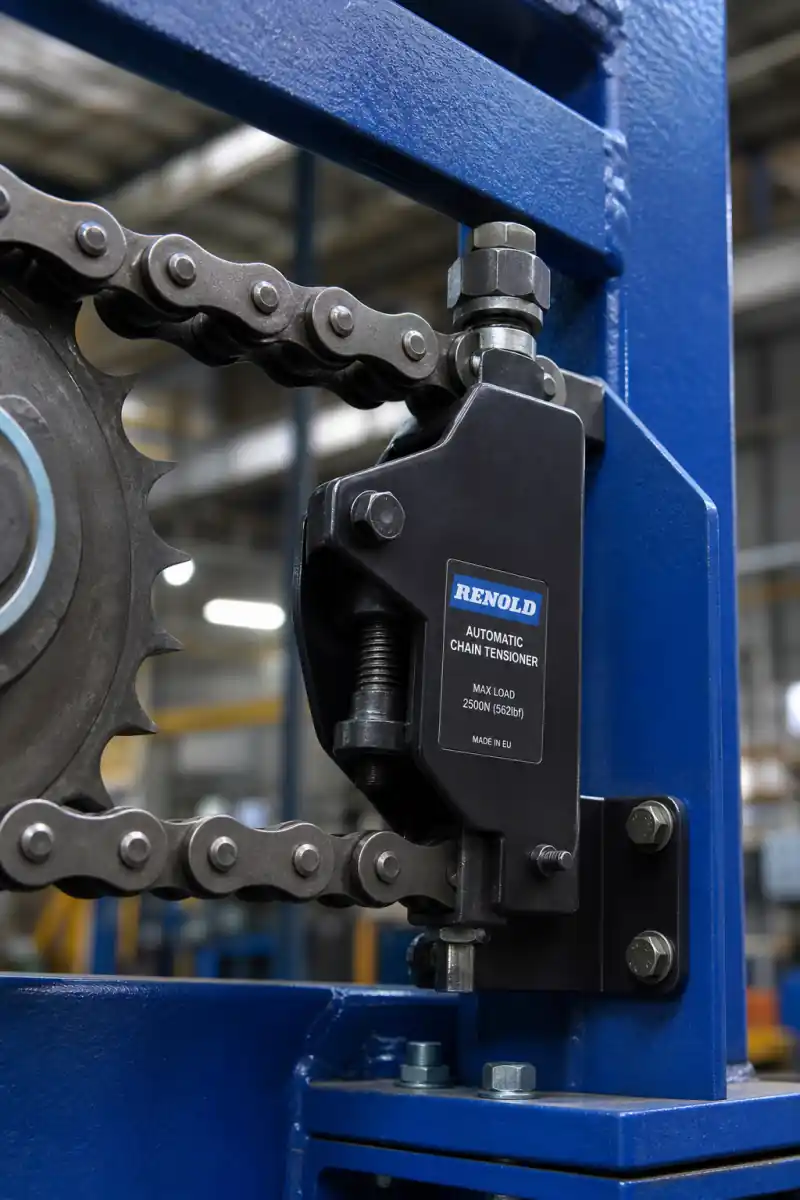
Chain tensioning systems, of the strategies that increase power transmission efficiency in chain and sprocket systems, are one of the fundamental elements. Correct tension ensures that the chain sits fully aligned with the sprocket, thereby minimising power loss. A chain system operating at optimum tension in accordance with ANSI/ASME standards can offer power transmission efficiency of up to 98%. This efficiency rate provides significant savings in energy costs at industrial facilities and has a positive effect on the carbon footprint.
In the event of insufficient tension, the chain jumps on the sprocket, creating irregular power transmission and sudden load fluctuations. Excessive tension, on the other hand, places unnecessary load on the shaft bearings, increases the fatigue rate of the chain pins and raises energy consumption. Both scenarios have a negative impact on operational costs. Particularly in the automotive, food and pharmaceutical industries, which require uninterrupted production, the cost of incorrect tension settings plays a decisive role in product quality and production continuity.
Effects on Wear and Expected Service Life
Wear analysis and service-life prediction in chain and sprocket systems our studies clearly demonstrate the decisive role of tension setting on chain life. The service life of chains operating under incorrect tension can be shortened by 40-60% compared to optimum conditions. This leads to significant cost increases, particularly in industries requiring uninterrupted production. Failures occurring outside planned maintenance intervals increase production losses and emergency repair costs.
Tension factors that directly affect chain life include ambient temperature, load variations, lubrication conditions and sprocket alignment. Each of these variables can cause deviations from the optimum tension value. For this reason, tension monitoring should be an integral part of a proactive maintenance strategy.
Types of Chain Tensioning Systems
Spring Tensioning Devices
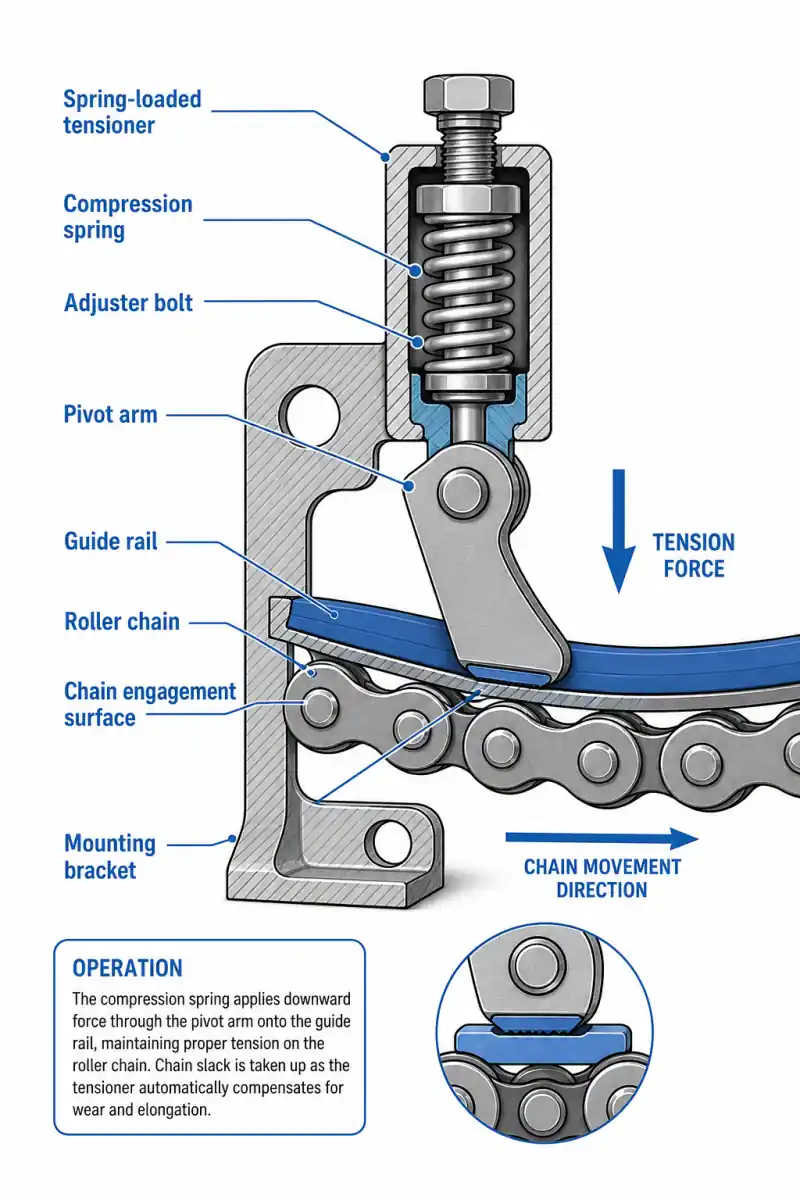
Spring-loaded chain tensioning systems are the most common solution, offering automatic tension compensation. The operating principle is simple yet effective: a spring mechanism automatically compensates for tension variations in the chain. These systems are particularly preferred in the following situations:
- Variable load conditions: Applications where chain length varies depending on load
- High-temperature environments: Systems where thermal expansion affects chain tension
- Transmissions with long centre distances: Configurations where chain sag is significant
Spring tensioning devices, as outlined in the industrial chain lubrication and maintenance guide , still require regular inspection but significantly reduce the need for manual intervention. The greatest advantage of spring-loaded systems is their ability to compensate for tension fluctuations without operator intervention. However, it should be remembered that spring calibration can deteriorate over time, so periodic spring replacements should be planned.
Fixed Tensioning Devices
Fixed tensioning systems are used in applications where the distance between shafts is adjustable. In these systems, tension is achieved by changing the position of a shaft. Fixed tensioning is preferred in the following situations:
- High-speed applications: High-rpm systems where spring oscillations could cause problems
- Reversing transmissions: Systems where the chain transmits power in both directions
- Applications requiring precise positioning: Situations where tension fluctuations are unacceptable
The most important point to consider with fixed tensioning devices is that changes in ambient temperature affect chain length. In transmissions with long centre distances, thermal expansion can cause problems in fixed tensioning systems. In such cases, it may be necessary to switch to spring-loaded or automatic tensioning systems.
Automatic Tensioning Systems
Hydraulic and pneumatic tensioning systems are becoming increasingly widespread in modern industrial applications. These systems work in conjunction with sensor-based tension monitoring to continuously maintain optimum tension. They are particularly preferred in uninterrupted production lines in the automotive, food and pharmaceutical sectors. Automatic tensioning systems operate in line with the Industry 4.0 concept, offering data collection and remote monitoring capabilities. This allows maintenance teams to monitor tension values in real time and detect potential issues before a failure occurs.
How to Measure Correct Chain Tension
Frequency Measurement Method
The most precise method for measuring chain tension is frequency analysis. In this method, a section of the chain is released and its vibration frequency is measured. Chain tension is calculated from the frequency value using the following formula:
T = 4 × m × L² × f²
Where:
- T = Chain tension (N)
- m = Mass per unit length of the chain (kg/m)
- L = Free length of chain released (m)
- f = Measured vibration frequency (Hz)
This method chain and sprocket load calculation is an important part of processes and is regarded as standard in precision industrial applications. The advantage of frequency measurement is that it allows quick, repeatable measurement without dismantling the chain. Modern digital frequency analysers now make millisecond-level precise measurements possible.
Sag Measurement Method
The most practical and widely used method is sag (deflection) measurement. When a specific force is applied to the midpoint of the chain between two sprockets, the resulting sag is measured. According to ANSI standards, the sag value should be between 2-4% of the centre distance.
Measurement steps:
- Create a straight reference line at the midpoint of the chain's upper strand
- Apply a specific force and measure the amount of sag in the chain
- Compare the measured value with the reference values
- Adjust the tension if necessary
- Verify by repeating the measurement after adjustment
The most important point to note in sag measurement is that it must be carried out on the upper strand of the chain, with the reference line determined along the line passing through the sprocket centres. The chain's own weight must also be taken into account during measurement.
Digital Tension Meters
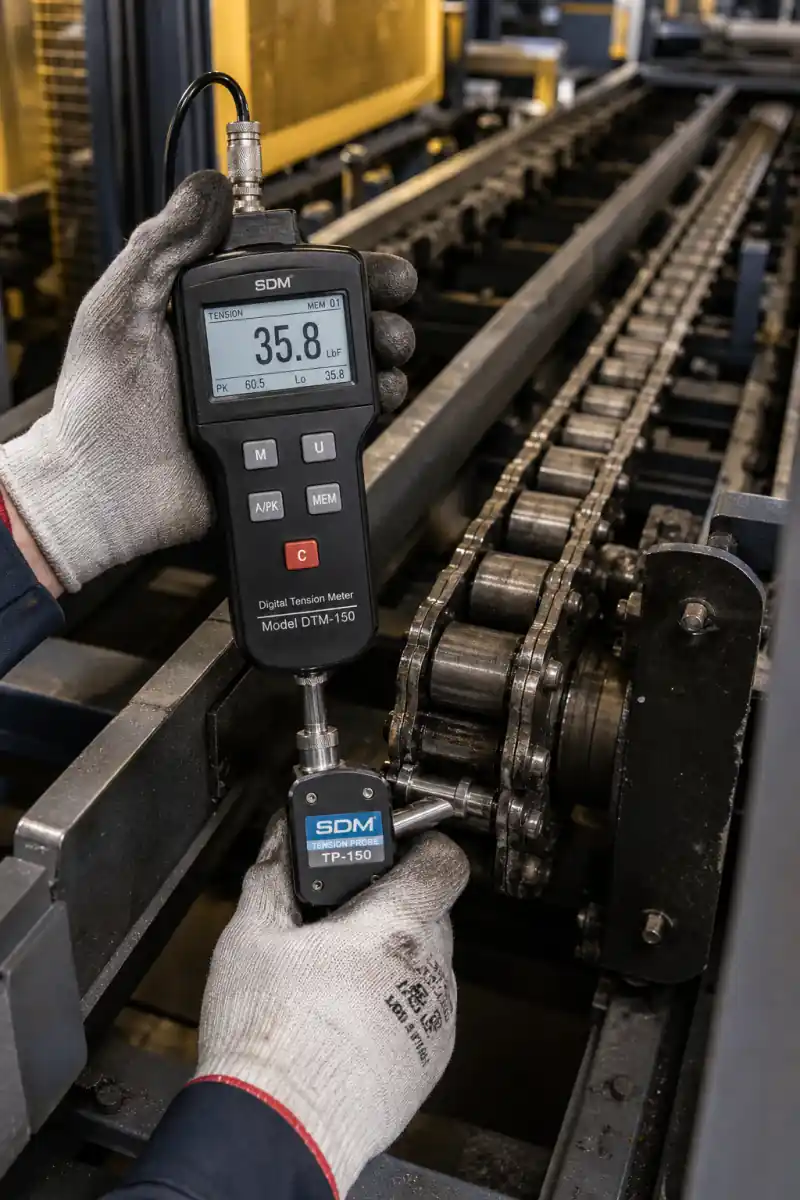
In recent years, digital tension meters have become standard in industrial applications. These devices display chain tension directly in Newtons or kilograms-force and can log calibration data. They offer particular convenience for maintenance teams carrying out periodic checks. Advanced models transfer data to mobile applications via Bluetooth, digitising maintenance records. This feature is a valuable tool in certification processes under ISO 9001 quality management systems.
Tension Adjustment Procedures in Industrial Applications
Tension Adjustment in Conveyor Systems
Conveyor belt systems and tension adjustment in chain conveyors is critical for handling capacity and system life. Points to consider in conveyor applications:
- Pre-load adjustment: Tension should be set with the system empty, then verified under full load
- Thermal expansion allowance: In long conveyors, temperature changes affect tension, and this must be taken into account
- Gradual tightening: Tension should be adjusted gradually rather than all at once
- Bidirectional systems: The tension balance in both directions should be checked
- Wear allowance: New chains will experience a reduction in tension during the initial running-in period, and this must be taken into account
Neglecting tension adjustment in conveyor systems can cause serious failures such as chain jumping, excessive wear and even chain breakage. Combined with production losses, the cost of these failures can reach tens of thousands of Turkish lira.
Tension Adjustment in Transmission Systems
Tension adjustment in transmission chains directly determines power transmission accuracy. Drawing on Gurur Makina's expertise in transmission chains, we recommend the following procedure:
- Initial installation: Fit the chain onto the sprockets and apply approximate tension
- Running test: Run the system at low speed to allow the chain to bed in
- Initial adjustment: Adjust the tension by measuring the sag
- Bedding-in period: Recheck the tension after 50-100 operating hours
- Periodic inspection: Verify the tension every 500 operating hours
In transmission systems, especially in high-speed applications, the precision of tension adjustment becomes even more critical. For systems running above 1500 RPM, sag values should be kept within 1-2%, whereas 2-4% may be more suitable for low-speed systems.
Common Chain Tension Errors and Solutions
Error 1: Excessive Tension
Over-tensioned chains apply unnecessary radial load to the shaft bearings. This leads to the following problems:
- Bearing wear and premature failure
- Increased power consumption (3-5% efficiency loss)
- Accelerated fatigue in chain pins
- Abnormal wear on sprocket teeth
- Increased noise level
- Abnormal rise in shaft and bearing temperature
Solution: Refer to the recommended tension values in the manufacturer's tables and verify them by measuring the sag. Excessive tension causes premature failure, particularly in bearing races, leading to unplanned downtime.
Error 2: Insufficient Tension
Loose chains cause jumping on the sprocket and irregular power transmission:
- The chain skips on the sprocket
- Irregular load transmission
- Localised wear on the chain and sprocket
- Increased vibration and noise
- Potential safety risk
- Excessive wear on chain guides
Solution: Adjust the tensioning mechanism or switch to a spring-loaded tensioning system. Insufficient tension not only accelerates chain and sprocket wear but can also pose a risk to workplace safety.
Error 3: Irregular Tension Checks
In many facilities, tension adjustment is regarded as a task carried out only after a failure occurs. Yet proactive tension management forms the foundation of planned maintenance strategies. The ISO 17356 standard recommends that tension checks be carried out at intervals determined according to operating conditions.
Solution: Integrate tension checks into the planned maintenance programme and keep digital records. Modern Computerised Maintenance Management Systems (CMMS) record tension measurement data as time series, enabling trend analysis. This approach detects gradual changes in tension, providing early warning before failure occurs.
Chain Tension Selection Table
The recommended tension ranges by application type are given below:
| Application Type | Tension Ratio | Sag (%) | Inspection Interval |
|---|---|---|---|
| Low-speed transmission | 1-2% of centre distance | 2-4 | 1000 hours |
| High-speed transmission | 1-1.5% of centre distance | 1-3 | 500 hours |
| Conveyor (horizontal) | 2-3% of centre distance | 3-5 | 500 hours |
| Conveyor (inclined) | 2-4% of centre distance | 2-4 | 250 hours |
| Motorcycle | Manufacturer specification | – | 1000 km |
This table is intended as general guidance only. For application-specific optimum tension values, manufacturer documentation and engineering calculations should be used as a reference. In very rigid environments or systems operating under shock loads, tension values may fall outside these ranges.
Tensioning System Selection Guide
Consider the following criteria when selecting the correct tensioning system:
Environmental Conditions
- Dusty environments: Spring-loaded systems may accumulate dust; fixed systems may be preferable
- High humidity: Choose corrosion-resistant tensioning elements
- Extreme temperature: Thermal expansion allowance must be taken into account
- Chemical exposure: Use specially coated tensioning elements in acidic or alkaline environments
Load Characteristics
- Constant load: Fixed tensioning arrangements may be sufficient
- Variable load: Spring-loaded or automatic systems should be preferred
- Shock load: Hydraulic tensioning systems are the most suitable solution
- Impact load: Spring-loaded systems absorb impact, preserving chain life
Maintenance Access
- Easy access: Manual fixed tensioning can be applied
- Difficult access: Automatic or remotely adjustable systems should be preferred
- Hazardous environment: Automatic tensioning systems are essential for safety
- Remote monitoring: Continuous control can be achieved with IoT-based tension monitoring systems
Industrial Standards and Compliance
The design and application of chain tensioning systems must be carried out within the framework of international standards. The main reference standards are:
- ISO 606: Transmission chain dimension standard
- ANSI B29.1: American chain standards
- DIN 8187: German chain standards
- ISO 17356: Chain tension measurement methods
- ISO 15654: Chain durability test methods
Gurur Makina provides all its products and services in accordance with these standards. For detailed technical information, see DIN 8187 standard documentation or ISO 606 chain standards may be referred to.
Conclusion
Chain tensioning systems have a direct impact on the performance, safety and service life of industrial power transmission and conveying applications. Correct tension settings extend chain and sprocket life, improve energy efficiency and prevent unplanned downtime. Incorrect tension, on the other hand, causes excessive wear, increased energy consumption and safety risks. Proactive tension management is a strategic investment that reduces total cost of ownership and increases operational reliability.
As Gurur Makina, with the experience we have gained in the transmission chain industry since 1986, we provide technical consultancy and product support on chain tensioning systems. Transmission chains and conveyor chains with our portfolio, we develop solutions suited to your industrial applications.
If you need expert support in selecting and applying chain tensioning systems, please contact us. Our experienced team is happy to offer tensioning solutions tailored to your application.