
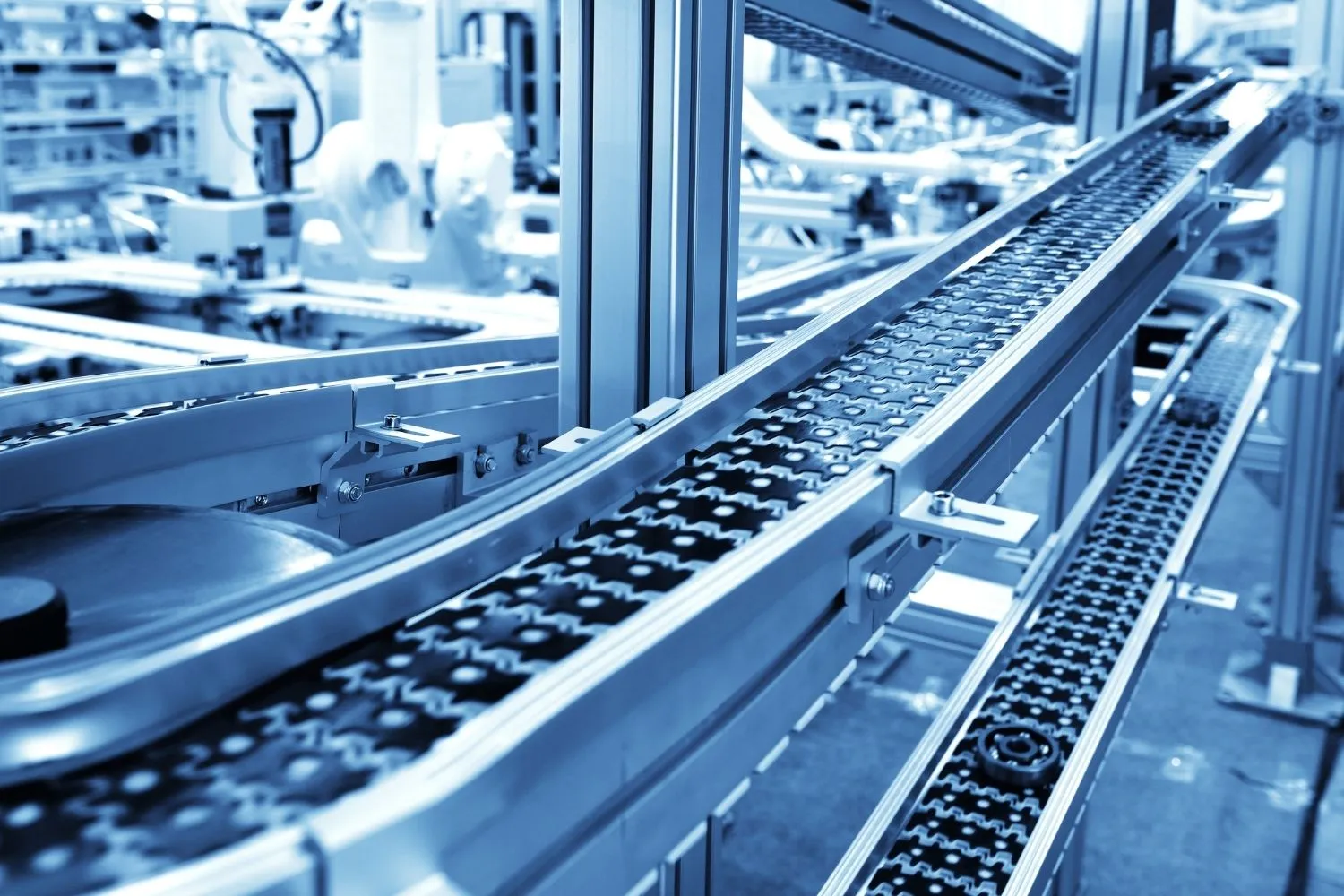
Industrial conveyor systems are material handling solutions that form the backbone of modern production facilities. Used across a wide range of applications, from factories to logistics centres and from food processing plants to mines, these systems have a direct impact on production efficiency. Industrial conveyor systems selection, when supported by the right chain and components, can increase facility performance by between 30% and 45%.
In this guide, we will examine every detail, from the basic types of conveyor systems to installation processes, and from maintenance strategies to chain selection criteria. In particular, transmission chains and conveyor chains we will look at how choosing a conveyor compatible with these will contribute to your facility's operational excellence.
What Are Industrial Conveyor Systems?
Industrial conveyor systems are mechanical devices that enable materials to be transported automatically from one point to another. First used in the mining sector in the 19th century, conveyors have now become an indispensable production tool in almost every industrial field. The basic principle is to convert motor power into load transfer via a conveying medium.
The basic components of a conveyor system include the drive unit, drive chain, conveyor belt or chain, return station, tensioning system and carrying bearings. Each of these components directly determines the overall performance of the system, and the right choice is the key to facility efficiency.
The History of Conveyor Systems
Konveyör sistemlerinin kökeni, 1900’lü yılların başına dayanmaktadır. Henry Ford’un 1913’te otomotiv montaj hattında bant sistemini kullanılmaya başlamasıyla endüstriyel konveyörler yaygınlaşmıştır. II. Dünya Savaşı sonrasında gelişen metalurji teknolojileri, daha dayanıklı zincir ve bant malzemelerinin üretimine olanak tanımış ve konveyör sistemleri modern görünümüne kavuşmuştur.
1986 yılından bu yana Türkiye’de zincir ve dişli sektöründe hizmet veren Gurur Makina, meeting facilities' conveyor needs with a wide range of products, from conveyor chains to transmission chains.
Basic Working Principle
Conveyor systems work by transmitting power from the drive motor, via the reducer, to the chain sprocket. The chain, rotating on the sprocket, moves together with the carrying medium (belt, pallet, bucket) to transport loads. The system's efficiency depends on the motor power being delivered to the carrying medium without transmission losses.
In this transmission chain, transmission chains plays a critical role. Choosing the right chain minimises energy losses while also determining the system's lifespan. The wrong chain choice, on the other hand, can lead to excessive wear, noise and energy waste.
Industrial Conveyor Types and Application Areas
Conveyor systems are designed in different types according to the transport method and industrial need. Each has its own advantages and application areas.
Belt Conveyors
Belt conveyors, the most common type of conveyor, transport materials placed on a continuous belt. Preferred for light and medium-load applications, belt conveyors are widely used in the food, logistics and packaging industries. Their advantage lies in low maintenance costs and quiet operation.
Chain Conveyors
Chain conveyors, distinguished by their heavy-load carrying capacity, use special chains that move on steel or cast pallets. They are particularly preferred in automotive, metallurgy and heavy industry applications. Industrial conveyor systems arasında en dayanıklı seçenek olan zincir konveyörler, 10.000 kg’a kadar tekil yük taşıyabilmektedir.

Pallet Conveyors
Pallet conveyors are specialised systems used to transport heavy and bulky loads. Moving on metal or plastic pallets, these conveyors are commonly found on assembly lines and in warehouse operations. Pallet conveyors are chain-driven and provide stable transport under heavy-load conditions.
Helical Conveyors (Screw Conveyors)
Screw conveyors used for transporting powder, granular and viscous materials are widely preferred in the food, chemical and construction industries. These systems, which convey material around a rotating screw shaft, stand out for their low maintenance requirements and compact design.
Bucket Conveyors (Elevators)
Bucket conveyors, used for vertical material handling, enable bulk materials such as grain, coal and sand to be transported across large elevation differences. The chains used in bucket conveyors are specially designed to withstand high tensile forces.
Roller Conveyors
Roller conveyors, driven by gravity or motor power, are used to transport unit loads such as boxes, pallets and containers. Indispensable for logistics centres and storage facilities, roller conveyors can be easily expanded thanks to their modular structure.
Selection Criteria for Industrial Conveyor Systems
Choosing the right conveyor system directly affects facility efficiency and return on investment. The key criteria to consider during the selection process are as follows:
Properties of the Conveyed Material
The physical and chemical properties of the material are a decisive factor in conveyor selection. The following parameters should be evaluated:
- Particle size: Whether the material is powder, granular or block form determines the type of conveyor
- Abrasiveness: Specially coated chains and belts are required for abrasive materials
- Temperature: Heat-resistant chain materials should be selected for systems operating at high temperatures
- Moisture level: Galvanised chains with high corrosion resistance should be preferred in humid environments
- Chemical exposure: Stainless steel chains should be used in acidic or alkaline environments
Capacity and Speed Requirements
Conveyor capacity is expressed as the amount of material to be transported per hour (tonnes/hour). The following factors play a role in capacity calculation:
- Chain speed (m/min)
- Load-carrying capacity of the transport unit (kg/unit)
- Distance between units (pitch)
- Operating time (hours/day)
- Safety factor (typically 1.2-1.5)
In high-capacity systems, transmission chains optimising power transmission is of great importance. Incorrect chain selection can prevent the system from running at full capacity and lead to wasted energy.
Environmental Conditions and Operating Requirements
The environmental conditions in which the conveyor system will operate directly affect material selection. The following environmental factors should be evaluated:
- Temperature range: -40°C’den +300°C’ye kadar değişen çalışma sıcaklıkları için farklı zincir malzemeleri gereklidir
- Moisture and dust: Special seals and protective coatings should be used in highly humid and dusty environments
- Chemical exposure: Stainless steel conveyor chains should be preferred in facilities with chemical vapour and splash risk
- Food contact: FDA-approved materials and hygienic design are mandatory in the food sector

Conveyor Chain Selection and Sizing
Chains, the heart of conveyor systems, negatively affect the performance of the entire system if not selected correctly. Chain selection must be made carefully according to the conveyor type and operating conditions.
Chain Types and Application Matching
The main chain types used in industrial conveyor systems are as follows:
- Roller chains: Preferred for light and medium-load applications requiring precise handling. Manufactured in standard ANSI and DIN sizes
- Bush chains: Used in environments requiring high wear resistance. Its bearingless design offers low-cost solutions
- Leaf chains: Used in vertical lifting applications. Common in lift and elevator systems
- Attachment chains: Özel aplikasyonlara göre tasarlanan, Gurur Makina’nın imalat kapasitesiyle ürettiği özelleştirilmiş zincirlerdir
In chain selection, parameters such as the connecting link type (open link, spring clip, riveted), lubrication method and material thickness should also be taken into account. Gurur Makina’nın sanayi sektöründeki deneyimiis a valuable reference resource for correct chain selection.
Chain Sizing Calculation
The basic parameters in chain sizing are as follows:
- Breaking load: The maximum tensile force the chain can withstand (kN)
- Pitch: The distance between two pin centres (mm)
- Inner width: The distance between the inner link plates (mm)
- Roller diameter: Roller outer diameter (mm)
- Safety factor: The ratio of the minimum breaking load to the working load (typically 5-8)
In the sizing calculation, the weight of the load carried, speed, acceleration forces and environmental factors (temperature, humidity, abrasiveness) must be taken into account. Inadequate sizing can lead to chain breakage and production stoppages.
Conveyor Assembly and Installation Process
The correct assembly of industrial conveyor systems directly determines the system's lifespan and performance. Incorrect assembly can cause premature wear, noise and energy waste.
Pre-Installation Preparation
Before the installation process begins, the following preparations must be completed:
- Facility planning: The conveyor route, support structures and electrical connection points should be determined
- Foundation check: The floor or structure on which the conveyor will be mounted must have the capacity to bear the load it will carry
- Component check: All components must be complete and undamaged, and chains must have been ordered in the correct size
- Safety planning: The installation area must be fenced off with safety barriers, and personal protective equipment must be provided
Installation Steps
A typical conveyor installation process includes the following steps:
- Frame assembly: The conveyor support frame is installed and aligned according to the design
- Drive unit installation: The motor, gearbox and drive sprocket are installed
- Chain fitting: The conveyor chain is threaded over the sprockets and tension is adjusted
- Electrical connections: The motor, sensors and control panels are connected
- Test run: Empty and loaded test runs are carried out
During the installation process, compliance with ISO 7149 conveyor safety standards and and DIN standards is of great importance.
Conveyor Maintenance and Service Life Extension Strategies
Regular maintenance allows conveyor systems to exceed their planned service life and prevents unexpected breakdowns. Industrial conveyor system maintenance is divided into proactive and reactive maintenance.
Proactive Maintenance Approaches
Proactive maintenance aims to prevent failures before they occur. The key elements of this approach are as follows:
- Regular lubrication: Chains and sprockets should be lubricated periodically according to manufacturer recommendations. Automatic lubrication systems prevent lubrication from being overlooked
- Chain tension control: Chains that are too loose or too tight accelerate sprocket wear and cause energy loss
- Wear monitoring: Zincir link uzaması periyodik olarak ölçülmeli, %2-3’lük uzama sınırı aşıldığında zincir değiştirilmelidir
- Vibration analysis: Abnormalities in bearings and sprockets can be detected early through vibration analysis
Reactive Maintenance and Emergency Response
Reactive maintenance covers the response to failures that have already occurred. Spare parts stock and a fast supply chain determine the success of reactive maintenance. Keeping spare stock, especially for conveyor chains and sprockets, minimises production downtime.
Gurur Makina’nın geniş zincir ve dişli stoku, acil durumlarda hızlı tedarik imkanı sunarak üretim kayıplarını en aza indirir. Contact You can get quick support from the page.
Energy Efficiency in Conveyor Systems
Energy efficiency directly affects the operating costs of industrial facilities. The following strategies can be applied to save energy in conveyor systems:
Choosing the Right Motor
IE3 ve IE4 verimlilik sınıfındaki motorlar, standart motorlara göre %2-5 daha az enerji tüketir. Değişken hızlı sürücüler (VFD) ile birlikte kullanıldığında, enerji tasarrufu %30’a kadar çıkabilir. Motor seçiminde, gerçek yük gereksinimlerinin doğru belirlenmesi aşırı boyutlandırmayı önler.
Gearbox Optimisation
Redüktör verimliliği, her kademedede %1-2’lik kayıp anlamına gelir. Helis dişli redüktörler (%95-98 verim), dik dişli redüktörlere (%90-95 verim) göre tercih edilmelidir. Reducer selection and maintenance you can find detailed information about this here.
Chain Friction Reduction
Chain friction is one of the biggest sources of energy loss in conveyor systems. To reduce friction:
- Correct lubrication method and lubricant selection
- Low-friction chain materials (polymer-coated bearings)
- Correct chain tension adjustment
- Clean, debris-free working environment
Safety Standards and Risk Assessment
Industrial conveyor systems are critical equipment in terms of occupational safety. Design and installation compliant with the Turkish Standards Institution (TSE) and international norms are essential for preventing accidents.
Basic Safety Measures
- Protective covers: Rotating parts (gears, chains, bearings) must be covered
- Emergency stop systems: Accessible emergency stop buttons must be installed along the conveyor
- Push bars: Long conveyors should have push bars that operators can use to intervene
- Coupling link safety: Missing or damaged coupling links increase the risk of chain breakage
Risk Assessment Parameters
Risk assessment in conveyor systems should be carried out based on the following parameters:
- Entrapment and drawing-in risk
- Falling material hazard
- Noise level (precautions required above 85 dB)
- Electrical safety (earthing, residual-current protection)
- Chemical exposure (oil, solvent, dust)
Sector-Specific Application Examples
Industrial conveyor systems require customised solutions across different sectors. Here are some sector-specific application examples:
Automotive Sector
Pallet conveyors and power-and-free systems are widely used on automotive assembly lines. High-capacity chain conveyors are preferred for transporting engines, chassis and bodies. Gurur Makina, for the automotive sector, provides customised chain solutions.
Food and Pharmaceutical Sector
Gıda sektöründe hijyenik tasarım, paslanmaz çelik zincirler ve FDA onaylı bantlar zorunludur. İlaç sektöründe ise temiz oda koşullarına uygun, partikül üretmeyen konveyör sistemleri kullanılır. Gurur Makina’nın pharmaceutical sector and food sector experience is a valuable resource in hygienic conveyor solutions.
Logistics and Warehousing
With the growth of e-commerce, the use of conveyors in the logistics sector is rapidly increasing. Roller and belt conveyors are widely used in sorting, consolidation and dispatch operations. The logistics sector demands conveyors that meet high-speed and precise sorting requirements.
Agriculture and Construction Machinery
In the agricultural sector, chains with high wear resistance are required for conveyors that come into contact with soil. For construction machinery, chain conveyors that can withstand impact loads and operate across a wide temperature range are preferred.
New Technologies in Industrial Conveyor Systems
Conveyor technology is constantly evolving. Digitalisation and automation are making conveyor systems smarter and more efficient.
Smart Conveyor Systems (Industry 4.0)
Industry 4.0 integration is transforming conveyor systems in the following ways:
- IoT sensors: Real-time monitoring with vibration, temperature and wear sensors
- Predictive maintenance: AI-assisted fault prediction and planned intervention
- Digital twin: Simulation and optimisation using a virtual model of the conveyor
- Autonomous control: AI-based speed and load optimisation
Sustainability and Green Conveyors
Environmental sustainability is becoming an increasingly important factor in conveyor design:
- Energy recovery systems (regenerative braking)
- Chains manufactured from recycled materials
- Energy savings with low-friction polymer bearings
- Solar-assisted conveyor systems (mining and open-pit applications)
Conclusion and Recommendations
Industrial conveyor systems, are critical equipment that directly determine the performance and competitiveness of production facilities. While correct conveyor selection, installation and maintenance can boost facility efficiency by 30-45%, incorrect selection and neglected maintenance can lead to serious cost losses.
We can summarise the topics covered in this guide as follows:
- The material being conveyed, capacity and environmental conditions are decisive in selecting the conveyor type
- Chain selection and sizing form the foundation of system performance
- Düzenli proaktif bakım, arıza maliyetlerini %60’a kadar azaltabilir
- Energy efficiency strategies deliver significant savings in operating costs
- Compliance with safety standards is both a legal obligation and an operational necessity
Endüstriyel konveyör sistemleri ihtiyaçlarınız için doğru zincir ve dişli çözümlerine ulaşmak, üretim kalitenizi artırmanın ilk adımıdır. 1986 yılından bu yana Türkiye’nin zincir markası olarak hizmet veren Gurur Makina, konveyör zincirlerinden transmisyon zincirlerine, kulaklı zincir imalatından özel projelere kadar geniş bir yelpazede çözüm sunmaktadır. By getting in touch with our expert team, you can explore conveyor solutions tailored to your facility.