
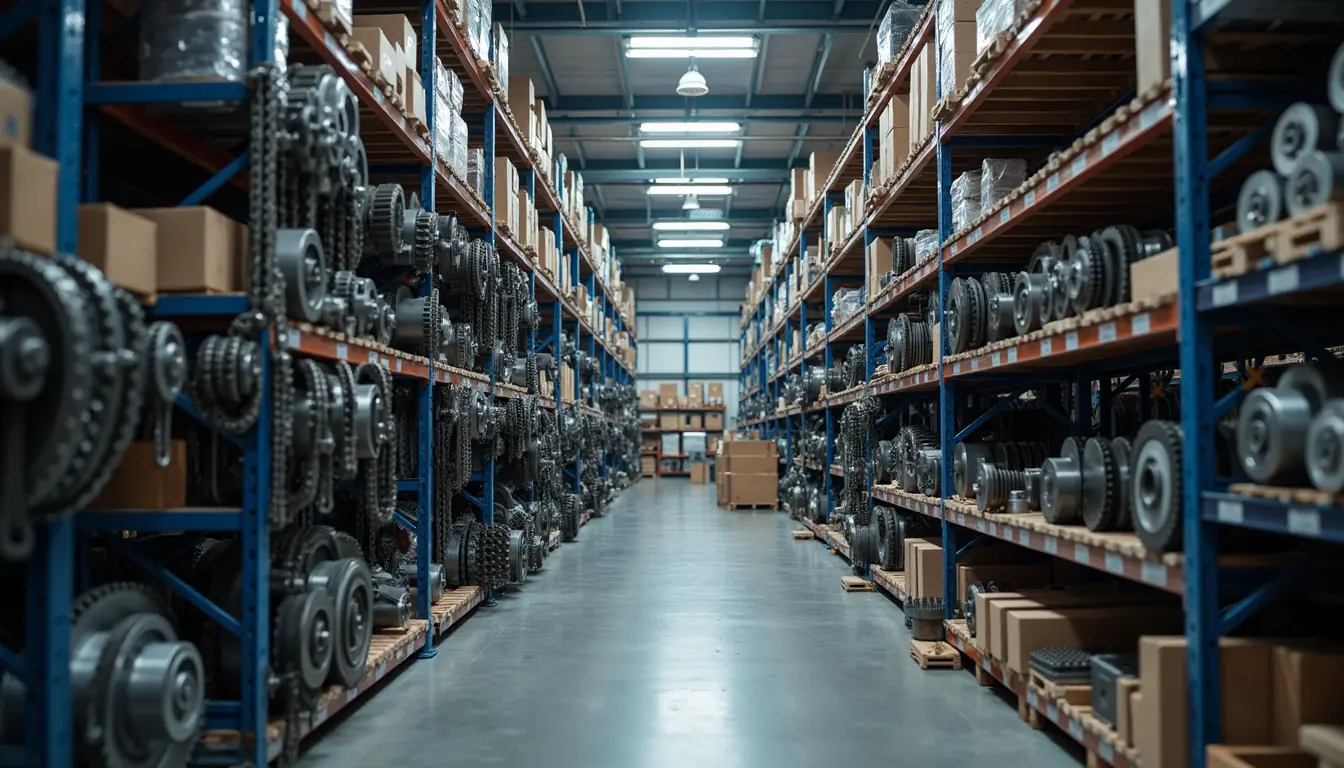
In industrial production environments, chain and gear systems form the backbone of power transmission. A conveyor line coming to a halt, unexpected wear in a gear system, or a break in the supply chain can paralyse entire production processes. This is precisely why choosing an industrial chain and gear supplier, is not merely a purchasing decision, but a guarantee of operational continuity.
So how do you know a supplier is “good”? Is a price list enough, or do you need to look more deeply into performance criteria? In this article, we will cover in full detail the technical and operational performance criteria you should look for in an industrial chain and gear supplier.
Why Are Supplier Performance Criteria Important?
Many businesses only consider the unit price when selecting a supplier. Yet in industrial chain and gear supply, cost is only the visible tip of the iceberg. The quality inconsistencies, late deliveries, stock shortages and lack of technical support lying beneath it turn a short-term price advantage into long-term losses.
Performance criteria enable you to measure not just how cheap a supplier is, but how reliable they are. Supplier selection made without these criteria relies on blind trust; yet in industrial environments, trust needs to be measurable.
The Role of Criteria in Risk Management
Supplier performance criteria are also a fundamental tool of risk management. Knowing which metrics you track also shows how long you could stay operational in the event of a supply disruption. Stock depth, the capacity to offer alternative products, and the ability to respond quickly in a crisis are concrete indicators of how these criteria play out in practice.
Technical Performance Criteria
Technical competence is the most critical area of evaluation for an industrial chain and gear supplier. The product's direct safety, durability and performance depend on the criteria in this area.
Material Grade and Hardness Level
The grade of the material used in chain and gear systems is the most important factor determining the product's service life. Different material grades, such as carbon steel, stainless steel and alloy steel, offer solutions suited to different application environments. The supplier must be able to correctly recommend the material grade appropriate to your application's operating conditions.
The hardness level, in turn, directly affects the material's wear resistance. While high hardness values increase resistance to wear, excessive hardness can cause brittleness. An experienced supplier should be able to determine the optimum hardness range based on the application's load and speed parameters.
Compliance with ISO and DIN Standards
Compliance with international quality standards is a fundamental indicator of a supplier's manufacturing discipline and product reliability. ISO 606 (chain sprockets), DIN 8187 and DIN 8188 (roller chains) define the product's dimensional tolerances, strength values and test procedures.
Compliance with standards also provides great convenience when spare part replacement is required. Non-standard products can be difficult to integrate into the system and may limit alternative supply options in the future.
Load Capacity and Safety Factor
Every chain and gear system is designed to operate under a specific load capacity. In addition to the nominal load capacities of the products it supplies, the supplier must also clearly state their safety factors. The safety factor is a performance indicator showing how much load a product can bear above its nominal capacity, and in industrial applications it is generally kept in the range of 5:1 to 8:1.
Products with a low safety factor can pose a safety risk during sudden load fluctuations. The supplier's ability to recommend the correct safety factor by taking your application's dynamic load conditions into account is an important proof of technical competence.
Temperature and Environmental Resistance
Industrial environments generally involve demanding working conditions. High temperature, humidity, dust, chemical vapours and corrosive substances directly affect the performance of chain and gear systems. The supplier must be able to classify its products according to such environmental conditions and provide the correct recommendation.
For example, chain and gear systems intended for the food sector require stainless steel or food-grade coatings. For oven systems operating at high temperatures, heat-resistant special alloys should be preferred. A supplier's ability to offer a product range tailored to such specific requirements is an indicator of its technical depth.
Operational Performance Criteria
Technical competence alone is not sufficient. A supplier's operational performance is felt directly in your day-to-day operations and forms the basis of your production planning.
Stock Depth and Ready Supply Capacity
For an industrial chain and gear supplier, stock depthis one of the most decisive operational criteria. How wide a range of products the supplier keeps in ready stock determines how quickly it can respond to urgent needs.
When assessing stock depth, attention should be paid not only to product variety but also to the stock quantity of each product. A supplier with a broad product catalogue but low stock quantities may experience delivery delays in urgent situations. It is important, for reliability, that the supplier provides transparent information about stock rotation and lead times.
Delivery Time and Deadline Assurance
Delivery time refers to the total period from order receipt to product delivery by the supplier. This period must be clearly defined for both standard orders and urgent requests.
Deadline assurance, on the other hand, indicates the supplier's compliance rate with its committed delivery date. A supplier that consistently delivers late will disrupt your production planning and may cause unplanned downtime. A supplier's past delivery performance is the most reliable indicator of its future deadline assurance.
Technical Support and Engineering Services
Industrial chain and gear systems are specialist fields requiring correct selection and application. Whether the supplier not only sells products but also provides technical consultancy services should also be among the evaluation criteria.
Topics that should be evaluated as part of technical support services:
- Application analysis: Ability to recommend the correct product according to working conditions
- Size calculation: Engineering calculations required for chain and gear compatibility
- Assembly support: Consultancy during system integration and initial assembly processes
- Fault analysis: Identifying the cause of faults that occur and proposing solutions
- Training: Organising practical training for maintenance staff
The presence of these services shows that the supplier is not merely a vendor, but a solution partner.
Quality Assurance and Certification
Quality assurance systems are key evidence that the supplier disciplines its production processes and ensures product consistency.
Production Certificates and Test Reports
An ISO 9001 quality management system certificate shows that the supplier's production processes are standardised and managed according to the principles of continuous improvement. In addition, product-specific CE marking, API certification, or other sector-specific certificates are proof that the product is manufactured in compliance with the relevant standards.
Test reports, in turn, provide concrete proof that the product complies with technical specifications. Tensile test, hardness test, fatigue test and wear test results enable the supplier to provide transparent information about product quality. Requesting and evaluating these reports is the most effective way to make an objective decision when selecting a supplier.
Traceability and Batch Tracking
In industrial applications, product traceability is a prerequisite for carrying out root cause analysis in the event of a quality issue and quickly identifying the affected batch. The supplier keeping records of the production date, material certificate and test results for each batch is a critical criterion in terms of traceability.

Supply Continuity and Risk Assessment
In industrial production, continuity is as important as quality. The supplier's ability to ensure an uninterrupted flow of products is a fundamental condition for operational stability.
Capacity to Offer Alternative Products
A good supplier does not create dependency on a single brand or product group. The capacity to offer multiple alternatives suited to your application both supports price competitiveness and provides protection against the risk of supply disruption.
The ability to propose alternative products also shows that the supplier has technical expertise and closely follows the market. A supplier that can recommend the most suitable solution for every application creates value in a long-term partnership.
Crisis Management and Emergency Response
How a supplier responds in unexpected situations reveals its true reliability. During crisis periods such as natural disasters, global supply chain disruptions or sudden surges in demand, a supplier's communication transparency, speed in generating alternative solutions and understanding of customer priority are performance indicators that cannot be observed in normal times.
The most practical way to evaluate this criterion is to ask for references on the supplier's performance during past crisis periods and to research their reputation within the industry.
Price-Performance Balance
Price is, of course, an important criterion in supplier selection. However, in industrial chain and gear supply, evaluating price purely as a unit cost means overlooking the total cost of ownership.
Total Cost of Ownership (TCO)
Total cost of ownership covers not only the product's purchase price but also all costs incurred throughout its lifetime. Installation, maintenance, energy consumption, downtime costs caused by failures, and spare parts expenses are all components of TCO.
A product with a low unit price but a high failure rate leads to a high TCO in the long run. Conversely, a product that is initially more expensive but reliable and long-lasting reduces the total cost. A supplier's ability to recommend products from a TCO perspective is key to building a value-driven partnership.
Warranty and After-Sales Support
Product warranty is the most concrete indicator of a supplier's confidence in their product quality. The scope, duration and ease of application of the warranty terms reflect the supplier's commitment to standing behind their product.
After-sales support is a service that continues even beyond the warranty period. The quality of services such as technical consultancy, maintenance planning, spare parts supply and emergency response plays a decisive role in long-term collaboration.
Supplier Evaluation Framework
Building an evaluation framework to systematically assess all these criteria is the most effective way to make objective and consistent decisions.
Criteria Weighting
Every business has different priorities. For a facility requiring continuous production, stock depth and delivery assurance may take priority, while for a business under cost pressure, the price-performance balance may be more decisive. Within the evaluation framework, you need to set the weight of each criterion according to your own operational priorities.
Performance Monitoring and Periodic Review
Supplier selection is not a one-off decision. Monitoring performance criteria periodically allows you to check whether the supplier is meeting their commitments. Monthly or quarterly review periods keep the supplier relationship transparent and allow you to identify potential issues at an early stage.
Sharing evaluation results with the supplier, identifying areas for improvement together and setting shared goals transforms the supplier relationship from a transactional purchase into a strategic partnership.
Conclusion
When selecting an industrial chain and sprocket supplier, performance criteria are the most powerful tool for turning subjective impressions into measurable data. Assessed under the headings of technical competence, operational reliability, quality assurance, continuity capacity and price-performance balance, these criteria provide the framework you need to make the right supplier decision.
At Gurur Makina, we embrace a partnership approach that puts performance criteria first in industrial chain and sprocket supply, offers technical consultancy, and guarantees continuity through stock depth. With our experience in Ostim and our product range, we continue to be the right solution partner for your business's power transmission systems.
For further information and technical consultancy, Gurur Makina you can contact us.